Showing posts with label Armenia. Show all posts

Tuesday, February 7, 2012

Why chess deserves a place in schools


Artwork by Mike Magnan

Why chess deserves a place in schools
In Armenia all six-year-olds study chess; in UK schools it 'fell off a cliff' in the 1980s. But its educational benefits are plentiful
Jonathan Calder
guardian.co.uk, Tuesday 7 February 2012 13.30 EST

Primary school children in Armenia have more to contend with than just the three Rs. From the age of six, they all study chess as a separate subject for two hours a week. Chess is important to the very identity of this landlocked little country. Armenia suffered massacres and repression in the 20th century and has recently experienced an economic collapse. Yet in the 1960s, it provided the Soviet Union with one of its succession of world champions in the shape of Tigran Petrosian. A master of defence, his relentless grinding down of opponents made him the Geoffrey Boycott of the chessboard. And today, Armenia – with a population of just 3 million – holds the men's world team title.

So it was no surprise when an official of the Armenian education ministry told the Associated Foreign Press that teaching chess in schools would "create a solid basis for the country to become a chess superpower". But there is more to it than that: Armenia is one of a growing number of nations hoping to see wider educational benefits from encouraging chess in schools. India, Turkey and Norway have all made similar moves recently, and a summary of research produced by the Quad Cities Chess Club in America talks of enhanced mental abilities and an improvement in conventional schoolwork.

This is not a new idea. The Soviet dominance of the game was rooted in the new regime's embrace of chess immediately after the revolution. The game was seen as a cheap way to bring culture to the masses and display the new state's superiority to the decadent capitalist west. "We must organise shock brigades of chess players and begin the immediate realisation of a Five-Year Plan for chess," declared Nikolai Krylenko, the father of Soviet chess – some years before Stalin had him arrested and shot.

The international master and chess journalist Malcolm Pein, a gentler soul, is one of those who want to see the game flourish again in British schools. "There is no other activity that costs so little to organise and that cuts across so many barriers," he says. "Age, sex, race, religion … they mean nothing in chess. Anyone can enjoy it. Around 500 million people in 167 countries play the game and only football can rival that. Yet it has long been in decline in our schools."

Two years ago, Pein's organisation, Chess in Schools and Communities, launched a pilot programme involving 60 primary schools and 6,000 children. By 2015 it aims to have introduced the game to 17,000 schools and to have a million children playing. It is an ambitious target, but so far they are on track. Chess is still played by many British children, and Pein praises the Delancey UK Schools Chess Challenge. However, his impression is that many of the 2,000 schools that take part come from the private sector.

Does this mean British chess has always been confined to a social elite? Pein suggests not. Talking about the match held by radio between Great Britain and the Soviet Union in 1946, he says: "Yes, the British team were all Oxbridge types – probably because everyone else was too busy earning a living. But if you look at photographs of the audience, they don't look particularly middle class." My own experience as a member of the feared Market Harborough team of the 1980s bears this out. When we won a trophy, it would be engraved with the names of all its previous holders. Until the 1960s these were overwhelmingly works or company teams: after that they barely featured. Looking at those trophies was like discovering a lost culture.

Chess held on for longer in state schools. Pein dates its decline – "it fell off a cliff" – to the 1980s, a decade that saw the narrowing of the curriculum and a subsequent disaffection among teachers. But it may not be too late to reverse that decline, because the memory of the benefits and pleasures of chess lingers. "When I talk to headteachers," says Pein, "they often say: 'We always had a chess club when I was at school. Why haven't we got one now?'"

Source: http://www.guardian.co.uk

Wednesday, January 18, 2012

Lessons for Life in 64 Squares


Lessons for Life in 64 Squares
Beloved in Armenia, chess becomes a mandatory part of the country’s curriculum.
by Sona Kocharyan

18 January 2012

YEREVAN | Arbi Khachatouryan teaches chess for a living, not an unusual job in a country where chess masters are treated like sports stars.

Khachatouryan, 30, works at the state-run Chess Academy of Armenia, but in September he began giving lessons twice a week at a primary school in Yerevan. He says he enjoys seeing second-graders’ relish for checkmating their classmates.

Not only their classmates. Grigor Gevorgyan, one of Khachatouryan’s students, revels in his newfound skill, boasting, “My grandfather is the best chess player in the world and I once mated him.”

But it is a class, after all, and there’s more to it than the thrill of conquest, Khachatouryan says. “Every day we start by going over the rules taught during the previous lesson. The children are eager to start their games, but revision is very important, too.”

Khachatouryan is not the only chess player teaching in Armenian public schools. In fact, since September more than 1,000 expert players and chess-savvy schoolteachers have been instilling the rules of the ancient game to 7-year-olds.

Armenia became the world’s first country to teach chess in every primary school and to include it in the national curriculum, Education and Science Minister Armen Ashotyan said in August, just before the new school year began and chess became a compulsory subject for second-graders.

“In the past Armenia often drew on the experiences of leading countries when making education reforms. Because of this innovation, the situation has changed. Now the eyes of the global educational community are on us,” Ashotyan said.

In 2010, the government tasked the Chess Academy with setting up a course. The Education Ministry experimented with teaching chess in two Yerevan schools in spring 2011 before recommending the program be expanded nationwide at a cost of 600 million drams ($1.5 million) in the 2011-2012 school year. The academy is responsible for writing textbooks and manuals and training chess teachers.

The academy even produced a psychology handbook to help chess teachers better understand how young children think and learn.

All 1,287 Armenian primary schools where second-grade classes are offered are taking part in the chess program, according to the Education Ministry. There are about 35,000 second-graders this year, all taking twice-weekly chess lessons. One lesson is an addition to their normal program and one replaces a physical education session.

Most of the new chess teachers are chess experts, and they are joined by teachers of math, informatics, and physical education, according to program organizer Varsine Manandyan of the Chess Academy.

After going through training sessions and seminars, aspiring chess teachers had to take an exam before 1,150 of them were hired for terms ranging from one to three years.

Chess experts do not expect every Armenian youngster to become a lifelong player, but they say the subject can help children in other areas of school and life.

“Six or seven is the best age for children to start learning chess,” says Tigran Petrosian, a 27-year-old grandmaster, no relation to the Tigran Petrosian who was world chess champion in the 1960s. “I also took my first steps into the field at the age of 6.”

Some chess instructors think the game will help children better understand subjects such as algebra, geometry, and logic.

“This game develops other values. The child learns to think, to make decisions, to play an honest game, to win and lose,” Chess Academy director Smbat Lputian says.

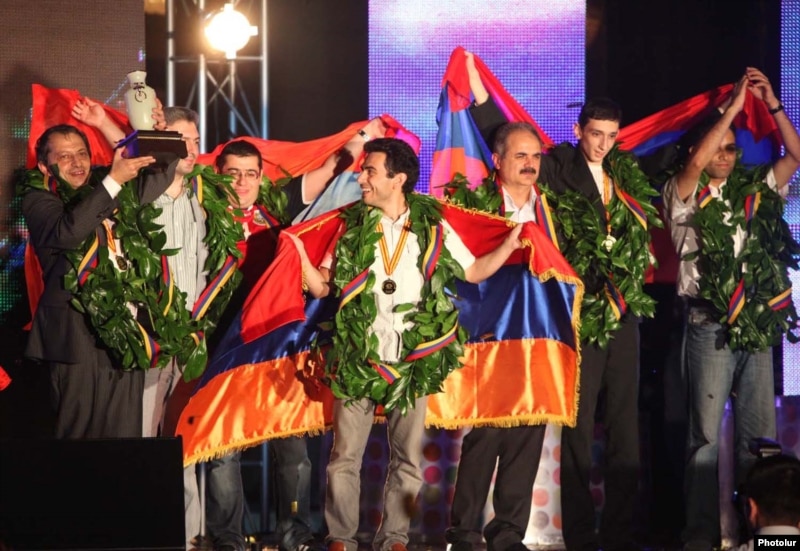
Armenians have an enviable record in the annals of modern chess. The country’s latest honor came last summer when the Armenian team led by Levon Aronian, the world's second-ranked player, won the world team chess championship. The Armenian team was heavily weighted with players who had won two consecutive world Chess Olympiads, in 2006 and 2008.

Chess has been among the country’s most popular pastimes since the original Tigran Petrosian became world champion in 1963 by beating one of the greatest Soviet players, Mikhail Botvinnik. Petrosian successfully defended his title in 1966 against Boris Spassky, finally losing it to Spassky in 1969.

“I was a little boy of 8, living in the small city of Meghri” at the time, writer Mesrop Harutyunyan says, recalling how Petrosian’s achievements set off a chess boom in Armenia. “I remember that everyone in town followed his matches and discussed every single move he made. It was like that not just in my city, but the whole country.”

Memories of past glory help explain why the government’s decision to teach chess in schools met with wide support. Another is that the country’s powerful president, Serzh Sargsyan, is also the chairman of the Armenian Chess Federation and liked the idea when Lputian, the federation’s vice president, suggested it.

The program has also been praised by educators, teachers, and parents, and Lputian says countries such as Russia, Azerbaijan, and Georgia have expressed interest in adopting it.

“My daughter takes painting classes twice a week. She’s also studying piano in a music school. So she wouldn’t have time to start learning chess if the school didn’t make it possible for her,” says Lilit Hakobyan of Yerevan, the mother of a second-grade student.

Gayane Saroukhanyan, a primary school principal in Yerevan, says the program is popular with her students’ parents. “The parents of third- and fourth-graders wish their children were also learning the subject, but in my opinion, this should be a gradually developing process,” she said.

And it will be. Compulsory chess lessons will be extended to the third grade next year and to the fourth grade in the 2013-2014 school year, according to Education Minister Ashotyan.

Article and photos by Sona Kocharyan, a journalist in Yerevan.

Source: http://www.tol.org

Monday, September 19, 2011

Armenia Introduces Chess As Mandatory School Subject


Armenia Introduces Chess As Mandatory School Subject
September 19, 2011

Chess has become a mandatory school subject across Armenia for every child over the age of 6.

School officials in Armenia say the move is aimed at fostering independent strategic thinking among future generations at school, at work, and in society.

The plan took effect beginning with the current academic year. More than 40,000 children in about 1,500 Armenian schools already have received chess textbooks and chess pieces. They are now receiving formal lessons twice a week from 1,200 specially trained and selected teachers.

Vachik Khachaturian, who has been teaching mathematics at school for years, decided to teach chess, too. He says the game is interesting and useful for his young students at Yerevan's Secondary School No. 125.

"First of all, chess is a game and it is fun. At the same time, it is an intellectual game," Khachaturian says. "Along with mastering the game the children learn to think independently. This [independence] makes the game interesting for them, especially at their young age."

Armenia already is one of the world's leading chess nations. The country boasts more than 30 grandmasters and gold-medal winners at the International Chess Olympiads in 2006 and 2008.

President Serzh Sarkisian presides over Armenia's Chess Academy and the national Chess Federation. He also has been involved during the past three years in developing the plan to teach chess in the nation's schools.

The director of Armenia's Chess Academy, grandmaster Smbat Lputian, initiated the project to introduce chess as a mandatory school subject. He says he strongly believes in the positive impact that playing chess can have upon children of a young age.

"Chess is an amazing game, amazing as I see only positive things in it," Lputian says. "It is a very fair game and this is the most important thing."

Sitting amid chessboards in the academy's tournament room, Lputian explains that he sees chess as a way to develop the ability of children to think independently.

"It makes you think and map out a strategy and while working on it, you need to assess your every move in advance and find the right one," Lputian says. "And with every move you need to make a decision, the whole game is about making decisions and these decisions should be primarily correct. The game makes you more accustomed to making serious decisions in difficult situations."

Chess also is regarded by most Armenians as an inclusive and universal activity, capable of uniting people of different ages and physical abilities.

Nevertheless, the project has encountered some opposition in the former Soviet republic.

Psychologist Ruzanna Gharibian is a supporter. She says playing chess helps the children not only to improve intellectual abilities, but also to develop essential personality characteristics that high-tech computer games are unable to provide.

"You know it is much better to create an atmosphere of real moral victory [for a child] by giving them these chessmen rather than giving them a computer and letting them experience victory through different aggressive [computer] games," Gharibian says.

Gharibian says playing the game of chess helps children develop responsibility and accountability for their actions.

Armenian chess players are greeted by thousands of people in Yerevan's Liberty Square to celebrate their victory in the 2011 World Chess Team Championship in July.

"You make a move and you bear a certain responsibility for the move you made," Gharibian says. "While playing computer games, children do not feel responsibility for their actions."

Studies conducted by Western scientists and chess masters in primary schools have confirmed that learning chess at an early age improves the reading performance of children, strengthens their problem solving skills, and has a positive effect on concentration, memory and calculation.

Source: http://www.rferl.org

Wednesday, August 31, 2011

Armenia moves forward with chess in all schools


Chess becomes compulsory subject in all secondary schools of Armenia from second grade
August 30, 2011 | 18:47

YEREVAN. - From September 1, chess will become a compulsory subject in all secondary schools of Armenia, said Armenian Minister of Education Armen Ashotyan and deputy chairman of the Armenian Chess Federation Smbat Lputyan in a joint press conference on Tuesday.

"Thus, Armenia becomes the first country in the world, where chess is included into state educational standards for secondary schools. In 2012, chess will be taught in 3rd grade, and in 2013 - in 4th. In 2013, the subject will be introduced in an elementary school in full," said the minister.

According to him, a textbook on chess, a special notebook, teachers’ textbook and a collection of exercises for practical work has already been published. The minister noted that by the end of this week all schools will receive a set of chess tables, boards and other necessary supplies. Chess classes will be set up in all schools.

AMD 900 million (about $ 2.5 million) has been allocated from the State Budget to introduce this subject.

Source: http://news.am